Building a brand used to take decades and millions in advertising spend. A television commercial here, a billboard there, a radio jingle that burrowed its way into public consciousness over years of repetition. Today, a single well-constructed social media campaign can introduce a brand to millions of people in a matter of days — and do it for a fraction of the cost.
But “well-constructed” is the operative phrase. The social media landscape is noisier than ever. Every brand, creator, and individual is competing for the same finite resource: human attention. Campaigns that cut through don’t do so by accident. They’re built with clarity, creativity, and strategic discipline.
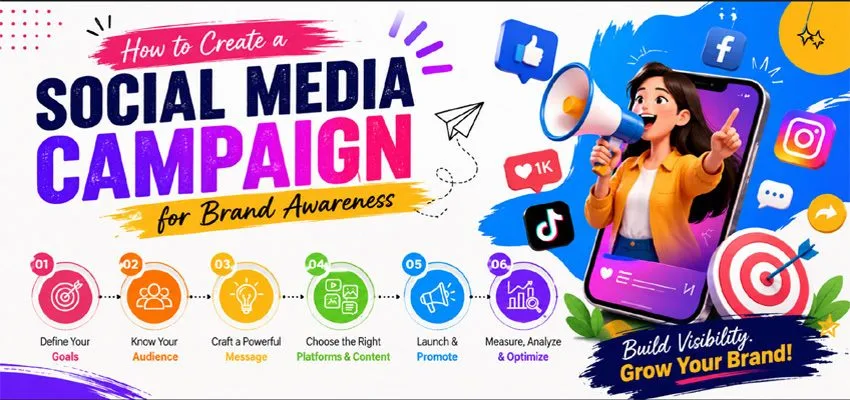
Here’s exactly how to build a social media campaign that puts your brand on the map.
Step 1: Define What Brand Awareness Means for Your Brand
Before touching a single content calendar or design brief, you need to answer a foundational question: what does brand awareness actually mean for you at this stage?
Brand awareness isn’t one-dimensional. It can mean:
- Recognition — people know your name when they see it
- Recall — people think of you when they encounter a product category
- Association — people connect your brand with specific values, emotions, or qualities
- Reach — your name is simply seen by more people than it was before
For a brand new to market, the goal might be pure reach — getting the name in front of as many relevant eyeballs as possible. For an established brand entering a new demographic or geography, it might be about reshaping associations. For a brand recovering from a reputation issue, it might be about rebuilding trust.
Being precise about your awareness objective shapes every creative and strategic decision that follows.
Step 2: Know Your Audience — Specifically
“Everyone” is not an audience. One of the most common reasons brand awareness campaigns fail is targeting that’s too broad to be meaningful. When you try to speak to everyone, you end up resonating with no one.
Build a clear picture of the specific humans you want to reach. Go beyond demographics into psychographics:
- What do they care about deeply?
- What do they read, watch, and share?
- What problems are they trying to solve?
- Which social platforms are they genuinely active on — not just registered on?
- What tone of communication do they respond to?
The more precisely you understand your audience, the more specifically you can speak to them. And specificity is what makes content feel personal rather than broadcast. It’s what makes a stranger stop scrolling.
Step 3: Choose the Right Platforms
Every social media platform is a different country with its own culture, norms, and native content formats. A campaign built for LinkedIn will fall flat on TikTok. Content designed for Instagram may never find traction on X (formerly Twitter). Platform selection isn’t about where your brand feels comfortable — it’s about where your audience actually spends their time.
Here’s a quick orientation:
Instagram excels for visually-driven brands in lifestyle, fashion, food, beauty, travel, and consumer goods. Reels offer enormous organic reach to new audiences; Stories build intimacy with existing followers.
TikTok is the dominant platform for reaching younger demographics through short-form video. Its algorithm is uniquely generous to new accounts — a brand with zero followers can achieve millions of views if the content resonates. It rewards authenticity and entertainment over polish.
LinkedIn is the uncontested home of B2B brand awareness. Thought leadership content, founder stories, industry insights, and company culture posts perform exceptionally well here among professional audiences.
YouTube suits brands with stories to tell at length — tutorials, documentaries, behind-the-scenes content, and interviews. It also functions as the world’s second-largest search engine, giving awareness content long-term discoverability.
Facebook remains powerful for reaching adults over 35, especially for community-building and local brand awareness through groups and targeted advertising.
X / Twitter works well for brands in news, tech, finance, sports, and entertainment — anywhere real-time conversation and commentary are native to the brand voice.
Resist the temptation to be everywhere at once. Two platforms done exceptionally well beat six platforms done poorly every time.
Step 4: Set Clear, Measurable Goals
Brand awareness can feel intangible, but your campaign goals shouldn’t be. Set specific, measurable targets before launch so you can evaluate success honestly.
Useful awareness-focused metrics include:
- Reach — the total number of unique accounts that saw your content
- Impressions — the total number of times your content was displayed (including multiple views by the same person)
- Follower growth — net new followers gained during the campaign period
- Share of voice — your brand’s mentions as a percentage of total category mentions
- Branded search volume — tracked via Google Trends or Search Console
- Video views and completion rates — especially for video-first campaigns
- Saves and shares — strong indicators that content was considered valuable enough to revisit or pass on
Attach numbers to these. “Increase reach by 40% over 8 weeks” is a goal. “Improve brand awareness” is a wish.
Step 5: Develop Your Campaign Concept and Creative Direction
This is where strategy becomes storytelling. Your campaign concept is the unifying idea that connects every piece of content — the thread that makes individual posts feel like parts of a coherent whole rather than random noise.
The strongest brand awareness campaigns are built on a single, clear insight about the brand or its audience. That insight becomes a theme, and the theme becomes content.
A few principles that consistently produce strong awareness creative:
Lead with emotion, not features. Nobody shares a bullet-point list of product specifications. People share content that makes them feel something — inspired, amused, understood, surprised. Your campaign’s job is to create those moments.
Be consistent but not repetitive. Define your visual identity for the campaign — a colour palette, a graphic style, a tone of voice — and apply it consistently. But express it in varied formats: a quote graphic, a behind-the-scenes video, a carousel post, a user-generated content feature, an interactive poll.
Tell your brand story. Awareness isn’t just about people knowing your name — it’s about them understanding who you are. Why does your brand exist? What do you believe? What’s the story behind the product? Campaigns that answer these questions build recognition and affinity simultaneously.
Create native content. Content that feels at home on a platform performs better than content that was clearly designed elsewhere and imported. This means shooting vertical video for TikTok and Reels, not repurposing horizontal YouTube videos. It means writing in the conversational register of X, not the formal language of a press release.
Step 6: Build a Content Calendar
A campaign isn’t a moment — it’s a sustained effort over time. Brand awareness compounds; repeated exposure to your brand across multiple touchpoints builds recognition far more effectively than a single burst of activity.
Map your content across the campaign timeline before publishing anything. A well-structured content calendar should include:
- Content type and format (video, graphic, story, poll, article)
- Platform and account
- Publish date and time
- Caption and copy
- Hashtags and tags
- Campaign phase (launch, momentum, conversion, close)
Most brand awareness campaigns run most effectively in phases. The opening phase focuses on pure reach and introduction. The middle phase deepens the story with more substance and engagement. The closing phase can include a call-to-action — a sign-up, a visit, a follow — that begins converting awareness into relationship.
Step 7: Amplify with Influencers and Partnerships
Organic reach on social media has declined across most platforms for most brands. Building a content calendar of original posts is essential, but it’s rarely sufficient on its own for a high-impact awareness campaign.
Two of the most effective amplification strategies are:
Influencer partnerships — working with creators whose audiences overlap with your target market. Crucially, the most cost-effective influencer partnerships for brand awareness are often not with mega-influencers with millions of followers. Micro-influencers (10,000–100,000 followers) and nano-influencers (under 10,000) typically have much higher engagement rates, more trusted relationships with their audiences, and more accessible fees. A campaign working with twenty micro-influencers often outperforms one mega-influencer deal at the same total cost.
Brand collaborations — partnering with a non-competing brand that shares your target audience. Co-created content, joint giveaways, and cross-promotions introduce each brand to the other’s audience with an implicit endorsement built in. Look for brands whose values align with yours and whose audience demographics match your target profile.
Step 8: Invest Strategically in Paid Amplification
Even modest paid social budgets can dramatically extend the reach of strong organic content. Rather than creating entirely separate paid creative, identify your highest-performing organic posts and amplify them with targeted spend.
Paid social is particularly powerful for brand awareness because platforms offer awareness-specific campaign objectives — reach and impression optimisation — that prioritise showing your content to as many relevant people as possible rather than optimising for clicks or conversions.
Use lookalike audiences (built from your existing customer data) to reach new people who share characteristics with those who already love your brand. Retarget people who’ve visited your website but haven’t yet followed you. Geographically target if local brand awareness is the goal.
The combination of organic content, influencer amplification, and targeted paid spend creates a multi-layered presence that dramatically accelerates recognition.
Step 9: Monitor, Learn, and Adapt
No campaign plan survives first contact with the audience entirely intact. Some content will overperform. Some will underperform. The brands that improve fastest are the ones that watch their data closely and adapt in real time rather than rigidly executing a plan that isn’t working.
Check your platform analytics weekly during the campaign. Note which content formats are generating the most reach and saves. Pay attention to the comments — qualitative feedback often reveals things quantitative metrics miss. If video content is dramatically outperforming graphics, produce more video. If a particular theme is sparking conversation, lean into it.
After the campaign closes, conduct a thorough debrief. Compare your results against your initial goals. Document what worked, what didn’t, and what you’d do differently. This institutional knowledge is one of the most valuable outputs of any campaign — it compounds into better performance on every future effort.
The Mindset That Separates Good Campaigns from Great Ones
The technical steps above are learnable by anyone. The mindset that separates average brand awareness campaigns from memorable ones is harder to teach, but worth articulating.
Great campaigns don’t interrupt audiences — they give audiences something worth stopping for. They treat every piece of content as an opportunity to earn attention rather than demand it. They understand that brand awareness isn’t built by shouting loudly; it’s built by saying something worth remembering.
When your campaign adds something genuine to someone’s day — a useful idea, a moment of entertainment, a feeling of being understood — you haven’t just raised awareness. You’ve begun building the kind of brand that people actually want to know about.
That’s the standard. Everything else is just execution.